
Reformer Pilates Socks That Hold on the Carriage
A reformer is not a mat. The carriage rolls, the footbar is a narrow padded rail, and the straps hang from a frame that moves with you. A bare foot or a plain cotton sock slides on all three. The sock you wear for reformer Pilates has a job a mat sock never gets: it has to hold on a surface that is itself in motion. This page covers what the machine asks of a sock, why studios make grip socks a rule, which style suits which exercise, and how to keep the sole grippy wash after wash.
What a reformer asks of a sock
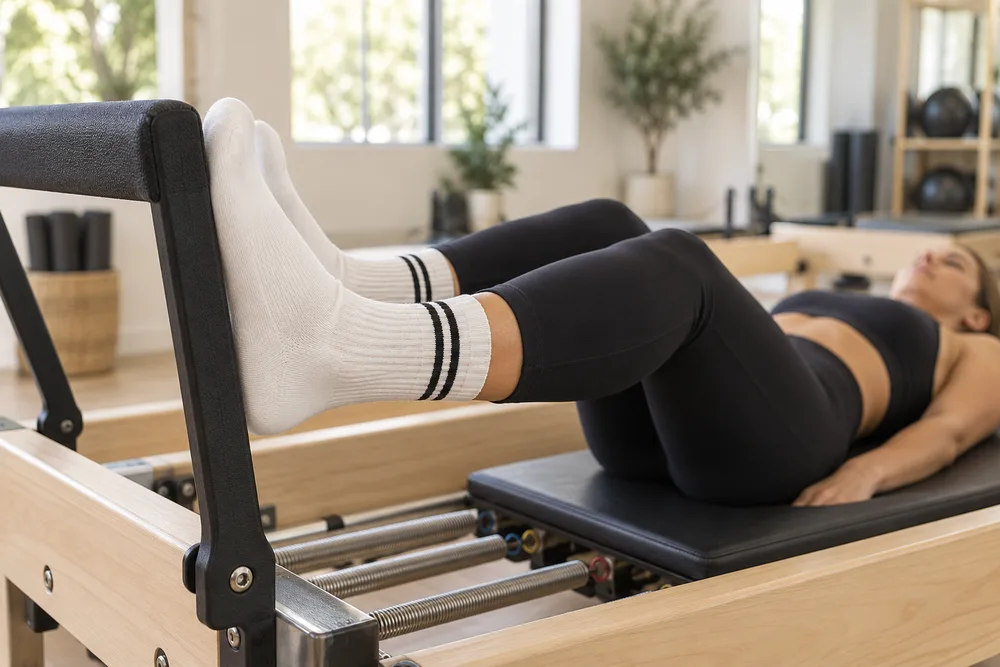
Three surfaces meet your foot on a reformer, and none of them behaves like a floor. The carriage is a padded platform on rails: push through your feet and it rolls away from you. The footbar is a narrow rail you press with your heels, your toes and your arches in turn. The straps loop around the arch or the heel. In one footwork series the foot flexes and points dozens of times. A sock has to hold on the smooth carriage, stay on the bar without bunching, and keep the strap seated in the arch while the foot keeps changing shape.
- Carriage: smooth, upholstered, moving. It needs a grip pattern across the whole sole, not a few dots under the ball of the foot.
- Footbar: narrow and padded. It needs a sole that grips a curved surface and a heel that stays on the bar through heel presses.
- Straps: a loop in the arch. It needs a knit that wraps the arch so the strap does not slide toward the toes.
- Footwork in flexion and extension: the sock must follow a pointed foot and a flexed foot without the cuff rolling down or the toe seam pinching.
Choose your reformer pack
Pick a pack, a style and your colors. One size, three styles, one price.
Your choice: Crew: Black
🔥 Selling fast — limited stock
Price shown before sales tax.
Prices in US dollars.
Complete your order
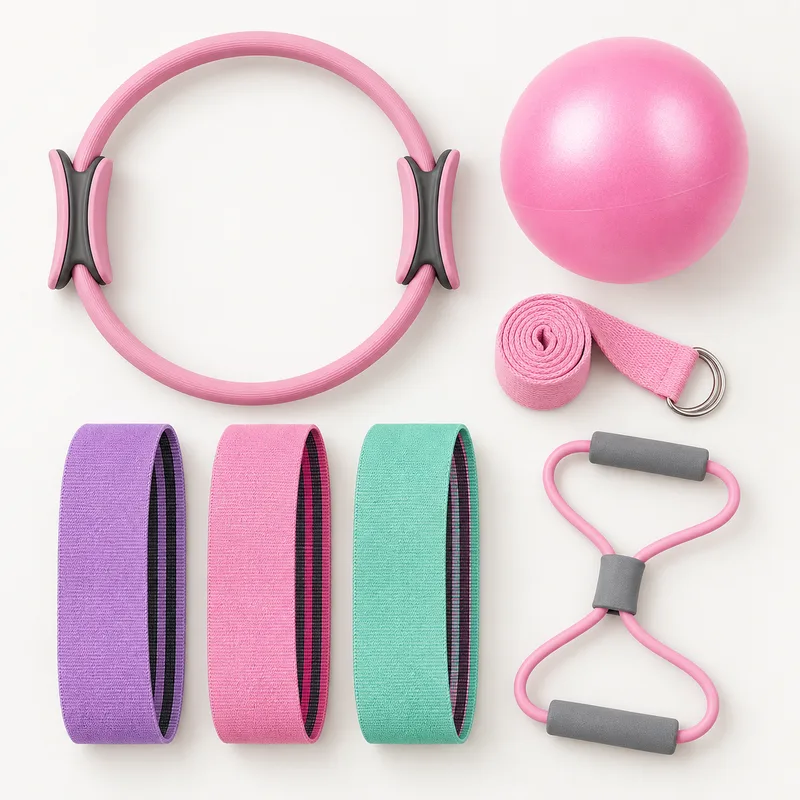
Pilates Kit $39
7 pieces: ring, ball, stretch strap, 3 hip bands, figure-8 expander
Ships in its own parcel, same delivery window.
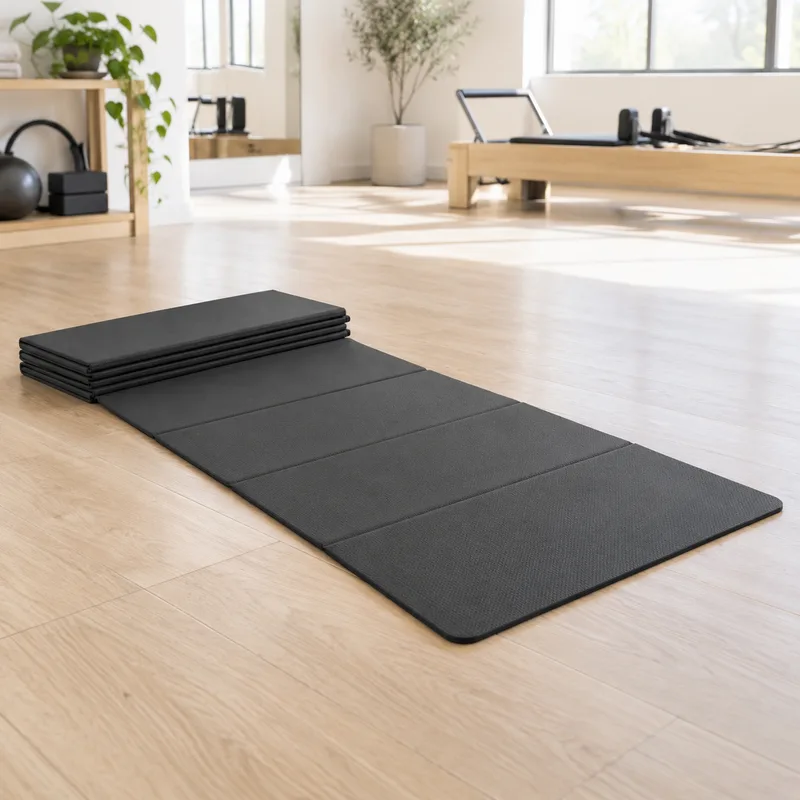
Folding Pilates Mat $29
TPE, 183 × 61 cm, folds flat for travel and small spaces
Ships in its own parcel, same delivery window.
Why most studios require grip socks on the reformer
Most reformer studios list grip socks as required, and the rule has two reasons. The first is hygiene. The carriage, the footbar and the straps are shared by every class of the day, and a sock is a layer between your skin and equipment that dozens of feet used before yours. The second reason is traction. A bare foot sweats, and a plain sock slides on upholstery. Either one lets the foot creep during footwork, and an instructor would rather cue your alignment than watch you chase the footbar. Grip socks answer both at once, which is why the front desk asks about them before your first class.
year-over-year growth in reformer Pilates reservations on ClassPass, the top Pilates format of the year
— ClassPass 2025 Look Back Report, 2025
More people on reformers means more feet on shared carriages, and more studios writing the sock rule into their welcome email. If you are not sure whether yours requires them, read do you need grip socks for Pilates, then ask the front desk. Studios that keep a basket of pairs for members will find pack sizes on Pilates socks for studios.
Which style for which reformer exercise
Pick by exercise, not by color. Here is how we match the three PIVELYA styles to the work you do most on the reformer.
| Reformer exercise | Style we suggest | Why |
|---|---|---|
| Footwork (heels, toes, arches on the footbar) | Ankle or crew | Full-sole grip on a narrow padded bar, a cushioned sole under the heel, and a cuff that stays put as you flex and point. |
| Running and tendon stretch | Ankle | Same bar, more heel travel. The double-loop cuff of the ankle style does not roll down between reps. |
| Feet in straps (leg circles, frogs, short spine) | Ankle or crew | The strap sits in the arch. A knit that wraps the arch keeps the strap from sliding toward the toes. |
| Jumpboard | Crew | You land flat with the whole sole. Honeycomb silicone spreads the grip across the board and the tall cuff stays up through repeated jumps. |
| Long stretch, elephant, knee stretches | Crew | Feet on the carriage, hands on the footbar. The carriage is the smooth surface, so a full-sole grip keeps the foot from creeping back. |
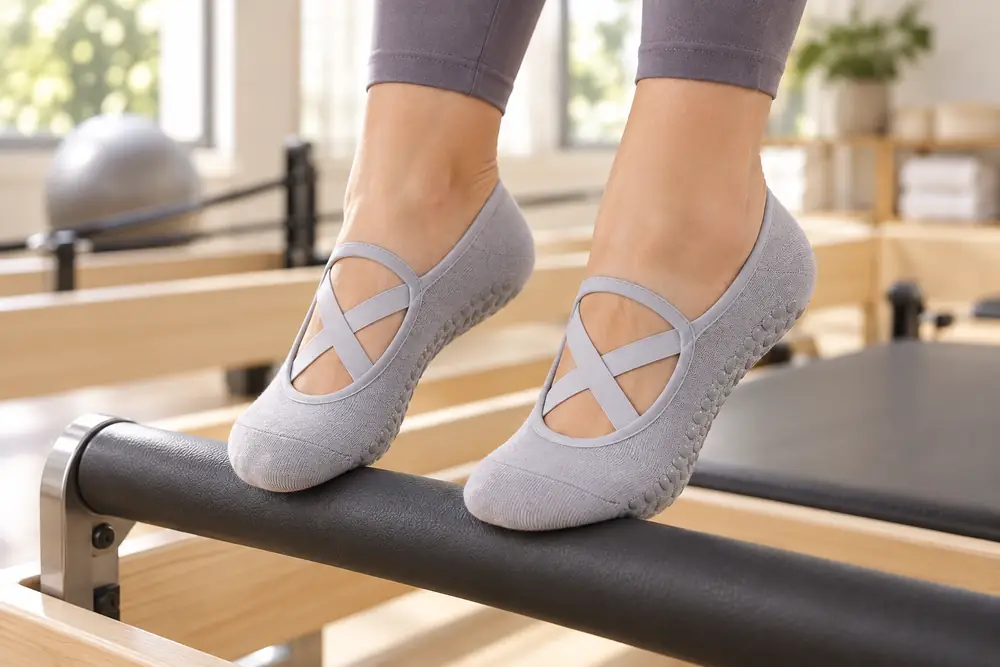
| Standing work (lunges, side splits, scooter) | Ballet or crew | Ballet holds with cross straps over the instep as the foot moves on the carriage. Crew covers the foot and the calf if your studio asks for a full sock. |
| Short box series | Ankle | The feet hook under a strap. A low cut keeps bulk out from under the strap and the flat toe seam sits without a ridge. |
| Stomach massage | Ankle or crew | Seated, feet on the bar, carriage moving under you: the same demands as footwork with more time on the toes. |
If you do a bit of everything, buy one pack in the style you use most, then add a single pair of the second style. A 3-pair crew pack covers jumpboard and long stretch days, and one ballet pair covers the standing series. A 6-pair pack of one style gets you through a full week of classes without a mid-week wash.
The three PIVELYA styles, side by side
| Style | Cut | Fabric | Colors | On the reformer |
|---|---|---|---|---|
| Crew | Mid-calf, ribbed cuff | Cotton and polyester knit | Black, White, Pink, Blue Gray, Purple | Jumpboard, long stretch, elephant, knee stretches: every drill where the full sole meets the carriage and the cuff must stay up. |
| Ankle | Low cut, sits at the ankle | Polyester and cotton knit | Black, Off-white, Gray, Pink, Purple | Footwork, running, stomach massage, feet in straps: a cushioned sole under the heel and a low cuff that does not roll. |
| Ballet | Cross straps, open instep | Polyester knit | Black, Gray, Pink | Standing work, lunges and side splits: the crossed straps hold the sock over the instep as the foot points and flexes on the carriage. |
All three come in one size. The ballet measures 8.3 in (21 cm) long by 3.1 in (8 cm) wide, the spec sheet's own dimensions, and the crossed straps over the instep take up the slack. The crew and the ankle rely on a high-elasticity cuff and a knit that wraps the arch. The sole pattern of each style is covered in detail on the non-slip Pilates socks page, and the open-instep fit on the ballet grip socks page.
Footwork in flexion and extension: the cuff matters as much as the sole
bones in a single foot, connected by many joints, muscles, tendons and ligaments, and a footwork series moves most of them
Footwork starts with the heels on the bar, moves to the toes, then the arches, then a prehensile position where the toes wrap the bar. In every one of them the foot flexes and extends against the springs. A sock with grip only under the ball of the foot loses contact the moment you shift to your heels. A sock with a loose cuff slides down after the first ten presses, and you fix it with your hands instead of holding your ribs down.
The crew style answers that with a high-elasticity ribbed cuff and two stripes that show at a glance which way is up. The ankle style answers it with a double-loop cuff and a toe that is hand-sewn flat, so there is no ridge between your toes and the bar. The ballet style covers the toes and the heel, leaves the instep open and holds through crossed straps. Verified buyers on our reviews page describe the socks as very soft, say the anti-slip grips do their job, and note that the sock doesn't come off easily. That is the whole brief for a footwork series.
Keeping the grip: our care routine for reformer Pilates socks
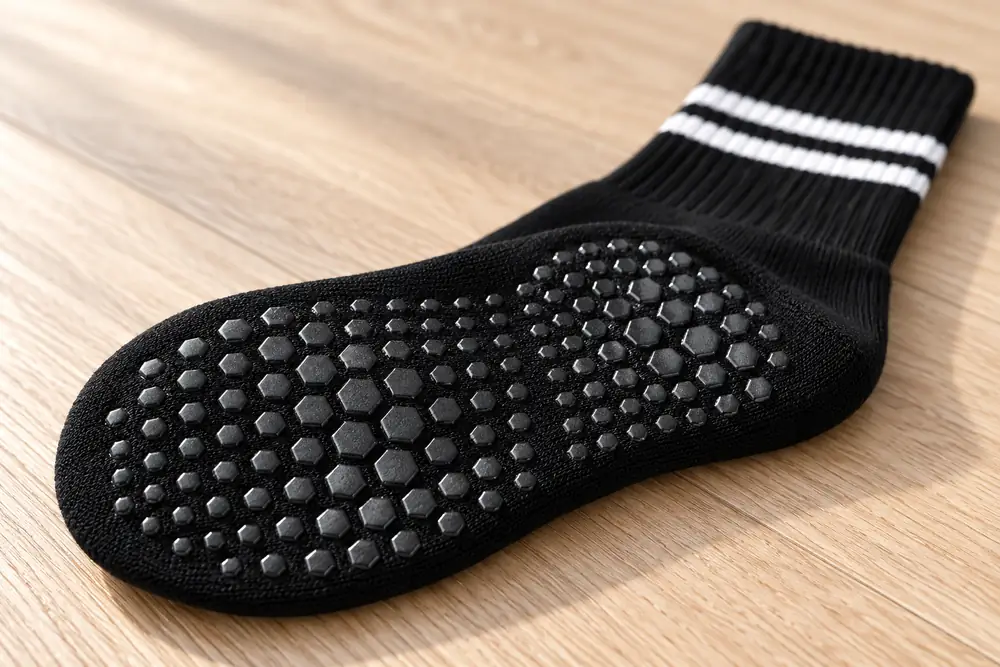
Silicone and rubber lose grip for two reasons: heat and residue. Dryer heat hardens the dots and cracks them at the edges. Fabric softener and studio floor cleaner leave a film that makes the dots glassy. This is the routine we recommend for a sock that sees a carriage three times a week.
- Turn the socks inside out. The grip faces in and rubs against fabric, not against the drum.
- Wash cold with a mild detergent, in a mesh bag with other socks.
- Skip fabric softener and bleach.
- Air dry flat, grip side up. Skip the dryer.
- Rotate. With three pairs, each one rests two classes between washes and the dots stay tacky longer.
- If the carriage felt slick last time, wipe the sole with a damp cloth before class. Floor cleaner transfers from the mat to the dots.
The full routine, and what to do when the dots feel slick after a few months, is in how to wash Pilates socks.
On a reformer the surface under your foot moves. A sock that holds on a wood floor can still creep on a carriage. Look at the sole first, the cuff second, the color last.Elise Hartley, Pilates instructor, mat and reformer since 2017
Where reformer Pilates socks fit in the range
Reformer socks are one use of the same three styles. For a mat-only practice, read Pilates socks for mat Pilates, where the sole matters less and the fabric matters more. For the criteria we use to judge any pair, see how we test and best Pilates socks. The range is rated 4.9 / 5 across 1410 verified ratings, and the reviews page breaks that down by style. The full range starts on the PIVELYA home page.
Elise Hartley · Pilates instructor · mat & reformer since 2017
Elise teaches mat and reformer Pilates and has worn and compared more than 40 pairs of grip socks on wood floors, reformer carriages and rubber mats since 2017. She writes every guide on this site and checks each product claim against the spec sheet's own data.
Reformer Pilates socks: your questions
What socks should I wear for reformer Pilates?
Wear grip socks with a non-slip sole that covers the whole foot, a cuff that stays put, and a knit that hugs the arch. For footwork and feet in straps, an ankle or crew style works well. For jumpboard, pick a crew. For standing work, a ballet style stays on through its cross straps as the foot points and flexes on the carriage. PIVELYA sells all three at one price, in one size.
Do you need special socks for reformer Pilates?
In most studios, yes. A regular sock slides on the carriage and the footbar, and bare feet are usually not allowed on shared equipment. Reformer socks have a silicone or rubber sole that holds on the carriage, and a snug fit that keeps the sock in place through flexion and extension. Check your studio's policy before your first class; most list grip socks as required.
What kind of socks for reformer Pilates?
Grip socks with a full-sole non-slip pattern, a cuff that does not roll, and a close knit. Crew socks cover the calf and stay up through jumps. Ankle socks sit low with a cushioned sole for footwork. Ballet socks hold with cross straps over an open instep for standing work. The kind depends on what you do most on the reformer; the table on this page matches exercises to styles.
What are the best socks for reformer Pilates?
By our criteria, the best reformer socks have four things: a grip pattern that covers the whole sole, a cuff that stays where you put it, a knit that wraps the arch so the straps sit still, and a sole that keeps its grip after washing. Judge a pair on those four points, then choose crew, ankle or ballet by exercise. Our reviews page shows what verified buyers report for each style.