
Non-Slip Pilates Socks That Stay Put on Wood, Mats and the Reformer
If you searched for non slip Pilates socks instead of grip socks, you asked the better question. Grip is the label on the packet. Non-slip is what you actually need to know: will your foot stay where you put it on a polished wood floor, on a mat, on a reformer carriage that rolls under you. This page explains the sole of each PIVELYA style, the floors it holds on, why the regular socks in your drawer slide, and which style to pick for your class. For the short version, start with what Pilates socks are and come back here for the sole.
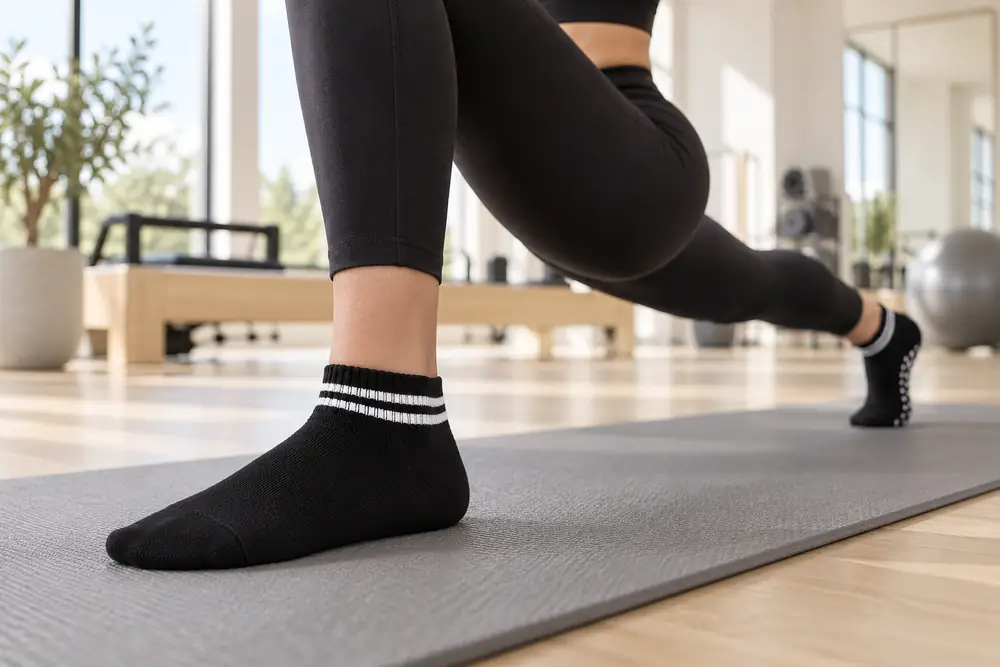
Choose your non-slip pack
Pick a pack, a style and your colors. Free shipping and a 30-day money-back guarantee on every pack.
Your choice: Crew: Black
🔥 Selling fast — limited stock
Price shown before sales tax.
Prices in US dollars.
Complete your order
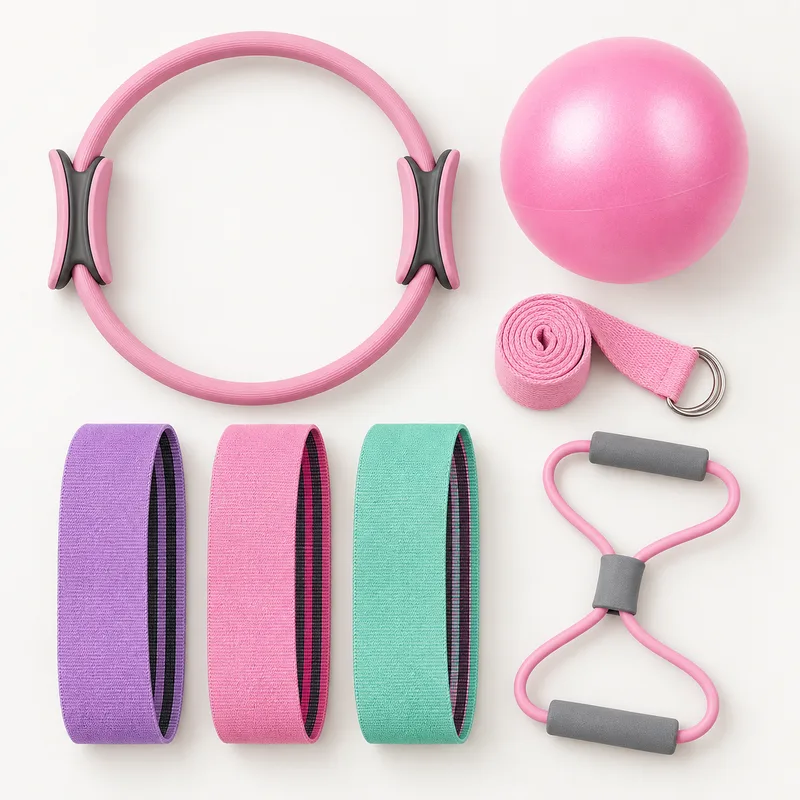
Pilates Kit $39
7 pieces: ring, ball, stretch strap, 3 hip bands, figure-8 expander
Ships in its own parcel, same delivery window.
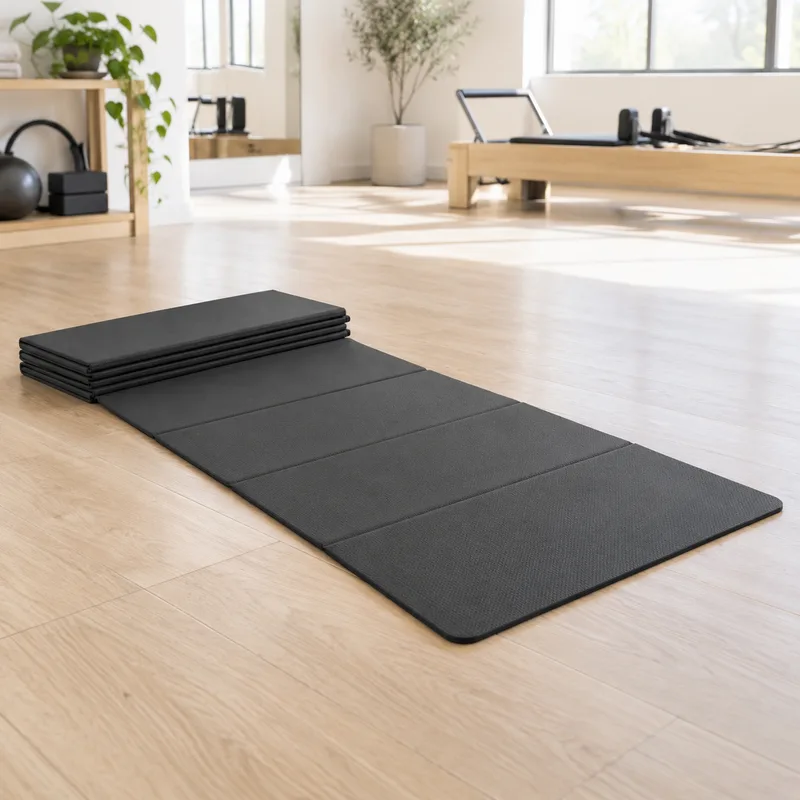
Folding Pilates Mat $29
TPE, 183 × 61 cm, folds flat for travel and small spaces
Ships in its own parcel, same delivery window.
What makes a Pilates sock non-slip
A non-slip sock has two parts that a regular sock does not: a sole with raised rubber or silicone that bites into the floor, and a fit snug enough that the sock does not spin around your foot. Take one away and the other stops working. A perfect grip on a sock that rotates still lands you on plain knit. Here is how each PIVELYA style handles both.
Crew: a honeycomb silicone grip across the whole sole
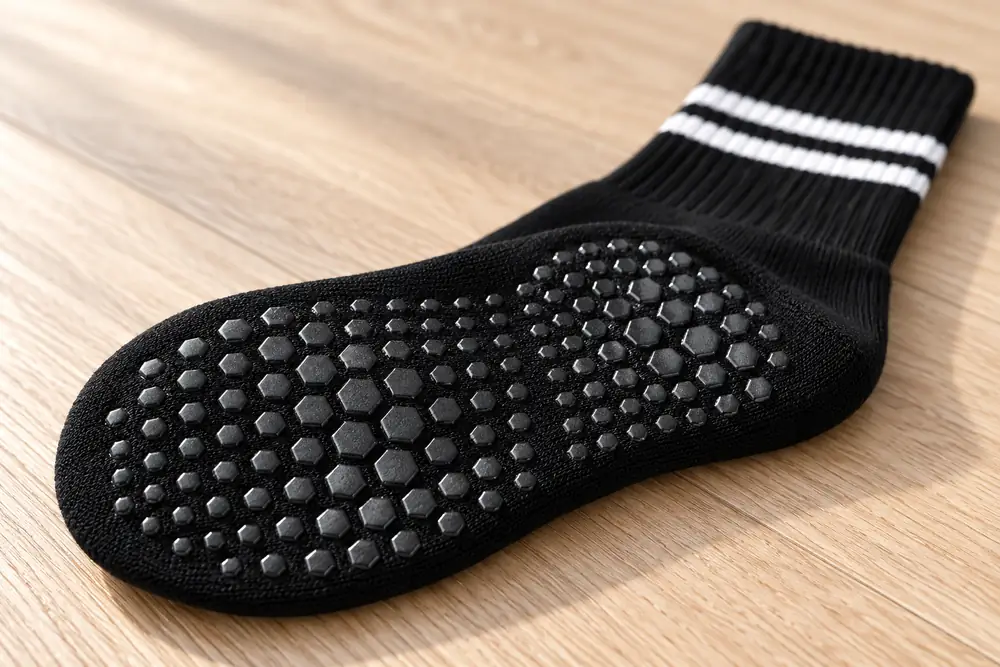
The crew is the style most people picture when they hear Pilates socks. It comes to mid-calf with a high-elasticity ribbed cuff and two stripes. Underneath, a honeycomb pattern of silicone covers the full sole, heel to toe, not just a patch under the ball of the foot. That matters on a reformer, where your heel drives into the footbar on one exercise and your toes on the next. The knit is a soft cotton and polyester blend that wraps the arch of the foot, so the grip stays under the foot when you point and flex instead of sliding toward the toes.
Ankle: a padded rubber sole that lands quietly on wood
The ankle sock sits low, right at the ankle bone, with a ribbed double-loop cuff. Its sole works differently: a rubber layer over a cushioned bottom, made to land softly and silently on a hard floor. The toe is hand sewn flat, so there is no ridge under your toes when you rise onto the ball of the foot at the barre. The polyester and cotton knit is breathable, and buyers describe it as light and dense at the same time. If your studio floor is warm and you dislike anything on your calf, this is the one.
Ballet: an anti-slip sole with cross straps and an open instep
The ballet style is a slipper cut. The sole, the heel and the toes are covered, the top of the foot is open, and two straps cross over the instep to hold the sole in place. You get the anti-slip sole under the ball of the foot and the heel, and less fabric over the foot than an ankle sock, with straps that keep the sock on through footwork on a pointed foot. The spec sheet lists it at 8.3 in (21 cm) long by 3.1 in (8 cm) wide, flat and before stretch. The ballet grip socks page covers the fit in detail.
Why a regular sock slides and a non-slip sock does not
A plain sock slides because two smooth surfaces meet: a flat knit and a sealed floor. Nothing on the sock catches the floor, and the moment you push sideways, in a lunge or a side-lying leg lift, the sock moves and your foot goes with it. Sweat makes it worse. Cotton soaks it up, the fibers flatten, and the sock turns into a slipper on wood.
A non-slip sock changes the contact surface. Silicone and rubber are tacky by nature. They deform slightly under load and cling to the floor instead of gliding over it. Silicone makers put the friction coefficient of the untreated material at around 1.0, and that tackiness is the whole reason grip soles are made of it. The raised pattern also lifts the knit off the floor, so the grip carries your weight, not the fabric.
coefficient of friction of untreated silicone, the naturally tacky material used for grip soles
— Jehbco Silicones, The Coefficient of Friction of Silicone, 2017
The second half of the job is the fit. A grip that holds the floor is wasted if the sock rotates around your foot. That is why the crew wraps the arch, the ankle has a double-loop cuff and the ballet has cross straps. Buyers say it on our reviews page: the socks stay put, they don't slide, and they feel snug without pinching.
Crew, ankle or ballet: pick by floor and class
The three styles share the same price and the same one-size fit. What changes is the sole, the height and the colors. One rule of thumb: the more the surface moves, the more sole you want.
| Style | Sole | Holds on | Best for | Height | Colors |
|---|---|---|---|---|---|
| Crew | Full-sole honeycomb silicone grip | Wood, cork, mat, reformer carriage | Reformer, mat, cold studios | Mid-calf, ribbed cuff | Black, White, Pink, Blue Gray, Purple |
| Ankle | Padded rubber sole with a cushioned bottom | Wood, vinyl, mat, carpet at home | Barre, mat, home practice | Low cut, sits at the ankle | Black, Off-white, Gray, Pink, Purple |
| Ballet | Anti-slip sole, cross straps over the instep | Mat, reformer, warm studios | Reformer footwork, standing work | Cross straps, open instep | Black, Gray, Pink |
Colors are sold per pair. A 3-pair or 6-pair pack is one style in any mix of its colors.
Which floors non-slip Pilates socks hold on
They hold on the floors you will actually meet in a class: sealed wood, cork, vinyl, a rubber or foam mat, the vinyl upholstery of a reformer carriage and the padded footbar. On carpet at home the grip matters less, because carpet already holds a sock, but the cushioned ankle sole still feels good on a hard subfloor.
Two conditions apply to any grip sock. The floor has to be dry: silicone does not cling through a film of water, so wipe the mat after a sweaty class. And the sole has to be clean: dust and lint sit between the grip and the floor, which is why a sock that picked up fluff in the dryer holds less. Both are habits, not products, and both take ten seconds.
Studios ask for grip socks for the same two reasons. Bare feet leave sweat on a shared carriage, and a plain sock slides on it. If you run a studio or teach in one, the Pilates socks for studios page explains packs by the half-dozen.
How to choose non-slip Pilates socks for your class
Every class loads the foot differently, and the sole that suits one is not always the first pick for another. Match the sock to the surface and the movement, not to the photo.
Mat Pilates
On a mat, the sock mostly has to hold during standing transitions and side-lying work, where the top foot presses into the mat. The ankle sock covers that on a warm floor. If the studio is cold or you practice on tile at home, the crew adds a cuff on the calf without changing the fit. Our guide to socks for mat Pilates goes exercise by exercise.
Reformer Pilates
On a reformer the carriage moves and your feet push against a bar at an angle. Full-sole grip matters here more than anywhere else. The crew covers heel and toes with silicone; the ballet covers the toes and the heel under an open instep, and the straps hold the sole steady through footwork. Most reformer studios ask for one of these two. The reformer Pilates socks page compares them exercise by exercise.
Barre
At the barre you spend the class rising onto the ball of the foot on a wood floor. Grip under the forefoot and a flat toe seam count more than height, which is why the hand-sewn ankle sock is the barre pick. Its cushioned bottom also makes the landings quieter in a room full of mirrors and hard floor.
At home
On carpet, any of the three works and the choice is comfort: crew if your feet run cold, ankle if they run warm. On a hard floor at home, treat it like a studio floor and take the crew or the ankle. Buyers who practice several times a week tend to take the 6-pair pack so a clean pair is always ready.
Keeping the sole non-slip, wash after wash
A grip sole loses hold in two ways: fabric softener coats the silicone, and heat bakes it. Our recommendation, and it is a recommendation rather than a manufacturer instruction, is simple. Turn the socks inside out, wash them cold in a mesh bag, skip the softener, and air dry them flat. Rotating three pairs spreads the wear and gives each sole a day to rest. Buyers report the grip holding through many washes. The full method is in how to wash Pilates socks.
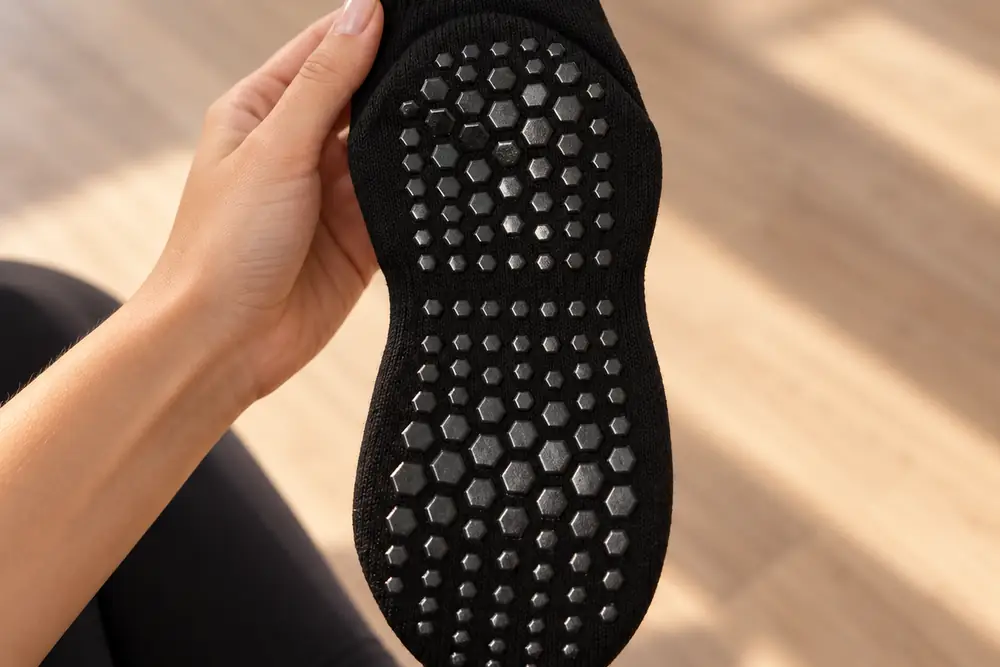
One more check before class: run a thumb across the sole. If it drags, the grip is ready. If it slides, the sole has picked up softener or lint, and a cold rinse brings it back. Sticky, grippy and non-slip all describe that drag, and what sticky really means explains how much of it you actually need.
By the numbersMore people on shared carriages, more reasons for a sole that holds
Pilates classes are fuller than they were, and reformer classes are the fastest-growing format. More feet on the same carriages is exactly why studios ask for a sock that holds and keeps sweat off the equipment.
increase in Pilates reservations in 2025 versus 2024, the third year in a row it was the most-booked workout worldwide
— ClassPass 2025 Look Back Report, 2025
year-over-year growth in reformer Pilates bookings, the most-booked Pilates format of the year
— ClassPass 2025 Look Back Report, 2025
Elise Hartley · Pilates instructor · mat & reformer since 2017
Elise teaches mat and reformer Pilates and has worn and compared more than 40 pairs of grip socks on wood floors, reformer carriages and rubber mats since 2017. She writes every guide on this site and checks each product claim against the spec sheet's own data.
See how we test for the criteria behind every claim on this page, and the PIVELYA home page for the full range.
Non-slip Pilates socks: your questions
Do you need non-slip socks for Pilates?
For reformer and barre classes, yes: most studios ask for them and many require them, because a plain sock slides on the carriage and bare feet leave sweat on shared equipment. For mat Pilates at home you can go barefoot, but a non-slip sock still holds during side-lying work and standing transitions on a hard floor.
What are the best non-slip Pilates socks?
Judge them on four things: a grip pattern that covers the whole sole rather than a patch, a cuff or strap that keeps the sock from spinning, a flat toe seam, and a knit that keeps its grip after washing. By those criteria, a full-sole silicone crew suits the reformer, a padded rubber ankle sock suits barre and mat, and a strapped ballet sock suits footwork.
What are grippy socks for Pilates?
Grippy socks, sticky socks and non-slip socks are three names for the same thing: a knit sock with raised silicone or rubber on the sole. The raised pattern clings to a wood floor, a mat or a reformer carriage where a smooth sock would glide. The rest of the sock, the cuff and the toe seam, decides whether it stays in place on your foot.
Can I do reformer Pilates without grippy socks?
Barefoot, sometimes: a few studios allow it, and bare skin does hold the carriage. In a regular sock, no. The carriage moves under you and your foot pushes into the footbar at an angle, so a smooth sock slides at the exact moment you load it. Check your studio policy, and bring a full-sole grip sock if it asks for one.